Visiting Alcobaça Monastery: History, Architecture & Pedro and Inês
September 24, 2026
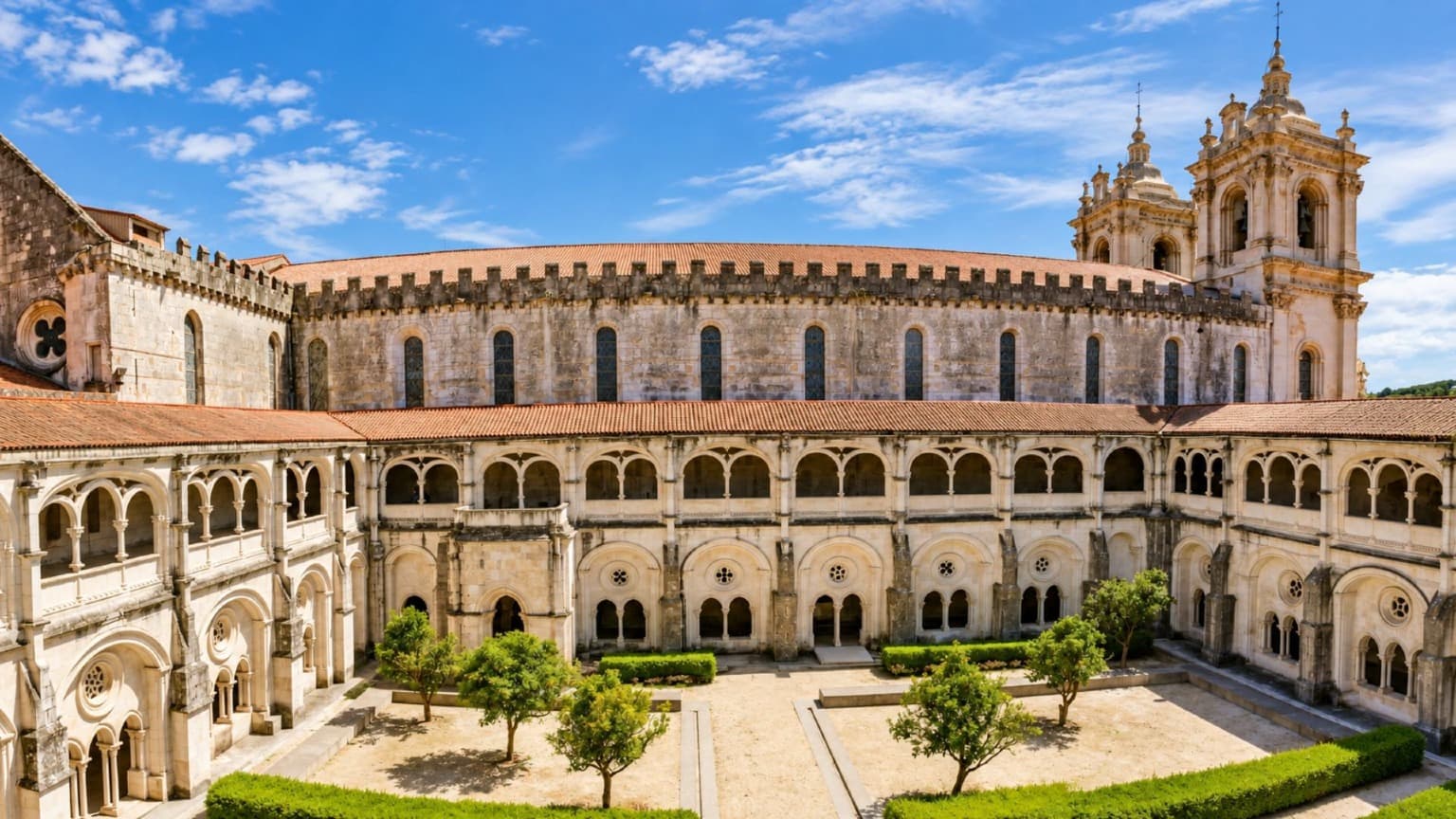
Beyond its imposing façade, Alcobaça hides remarkably preserved medieval spaces, from vaulted cloisters to a once fully functioning monastic kitchen.
In the heart of Central Portugal, the Monastery of Alcobaça is one of the country's great medieval monuments.
Founded in the 12th century and closely connected with the beginnings of the Portuguese monarchy, the monastery became one of the most important Cistercian centres in Portugal. Its enormous church, medieval cloister and remarkably preserved monastic spaces reveal a world shaped by prayer, work, discipline and the Cistercian ideal of simplicity.
But Alcobaça also preserves one of the most powerful stories in Portuguese history.
Inside the church lie the extraordinary Gothic tombs of King Pedro I and Inês de Castro, whose tragic relationship has been retold for centuries and transformed into Portugal's most famous love story.
Architecture, history and legend come together here in a monument that has been part of the UNESCO World Heritage List since 1989.
Alcobaça Monastery at a Glance
Founded: 1153
Religious order: Cistercian Order
Architectural highlight: Cistercian Gothic architecture
UNESCO World Heritage: Since 1989
Don't miss: The church, tombs of Pedro and Inês, D. Dinis Cloister, Refectory and Monastery Kitchen
Allow: Around 1.5 to 2 hours for a comfortable visit
Why Alcobaça Monastery Matters
The history of Alcobaça Monastery is closely connected with the foundation of Portugal itself.
In 1153, Portugal's first king, Afonso Henriques, granted extensive lands around Alcobaça to the Cistercian Order. The donation followed the Christian conquest of Santarém and helped establish a religious community that would have an enormous influence on the surrounding territory.
Construction of the monastery began in 1178, and the complex that developed here became one of the great Cistercian establishments of medieval Europe.
The Cistercians followed an ideal centred on simplicity, discipline, prayer and work. Their architecture reflected many of the same principles.
Step inside the monastery church and this becomes immediately apparent.
Instead of overwhelming visitors with decoration, the enormous central nave is defined by height, proportion, pale stone and light. Consecrated in 1252, the church became a landmark in the development of Gothic architecture in Portugal.
The monastery continued to evolve over the centuries, gaining new spaces and architectural elements as different periods left their mark. It also became an important centre of learning and religious culture.
Yet despite those later additions, the clarity of its Cistercian origins remains one of the defining characteristics of Alcobaça.
Pedro and Inês: A Love Story Immortalised in Stone
Walk towards the transept of the church and Alcobaça reveals another reason for its importance.
Here stand the tombs of King Pedro I and Inês de Castro.
Their story began in the 14th century, when Pedro, heir to the Portuguese throne, fell in love with Inês despite being married to Constança Manuel. Their relationship became entangled in the politics of the Portuguese court and eventually ended in tragedy when King Afonso IV, Pedro's father, ordered Inês's death in Coimbra in 1355.
Pedro later became king, and the story of his relationship with Inês passed from history into literature, legend and Portuguese collective memory.
Their monumental tombs, commissioned by Pedro and created around 1360, are among the finest examples of Gothic funerary sculpture in Portugal. UNESCO itself highlights them as exceptional expressions of Gothic sculpture and of the relationship between Alcobaça and the Portuguese monarchy.
Look closely rather than simply admiring them from a distance.
Pedro's tomb contains an extraordinary wealth of sculptural detail, including representations traditionally interpreted as the Wheel of Life and Wheel of Fortune, while both tombs combine religious imagery, human figures and symbolism surrounding death and eternal life.
A popular tradition holds that Pedro had the tombs positioned facing one another so that he and Inês would see each other again on the Day of Resurrection. Historical evidence, however, indicates that the tombs were originally placed side by side and were only rearranged to face one another centuries later. The famous arrangement therefore belongs to the later history of Pedro and Inês, showing how their story continued to be reinterpreted long after their deaths.
👉 Want to discover the full story of Pedro and Inês? Read our article about Pedro and Inês de Castro: Portugal's Most Tragic Love Story, from their relationship and Inês's murder in Coimbra to the legends that emerged after her death.
What to See Inside Alcobaça Monastery
The church and royal tombs may provide the most immediate impression, but much of the fascination of Alcobaça lies beyond them.
Walking through the monastery allows you to understand how a major Cistercian community actually functioned.
• The Church and Central Nave
Begin with the church itself.
Its scale is monumental, yet the interior remains remarkably restrained. Tall columns and Gothic vaulting guide the eye towards the transept, while natural light entering through the rose window and other openings reinforces the simplicity of the pale stone.
This combination of scale and austerity is fundamental to the character of Alcobaça.
The church was not designed around decorative excess. Its architecture was intended to create order, harmony and a setting appropriate to monastic life.
• The Tombs of Pedro and Inês
Even if you already know their story, spend some time examining the tombs themselves.
Beyond their romantic association, they are remarkable works of medieval sculpture. Angels watch over the recumbent figures, while intricate scenes and symbols cover the stone beneath them.
The tombs are among the monastery's greatest artistic treasures and are recognised by UNESCO as outstanding examples of Gothic funerary sculpture.
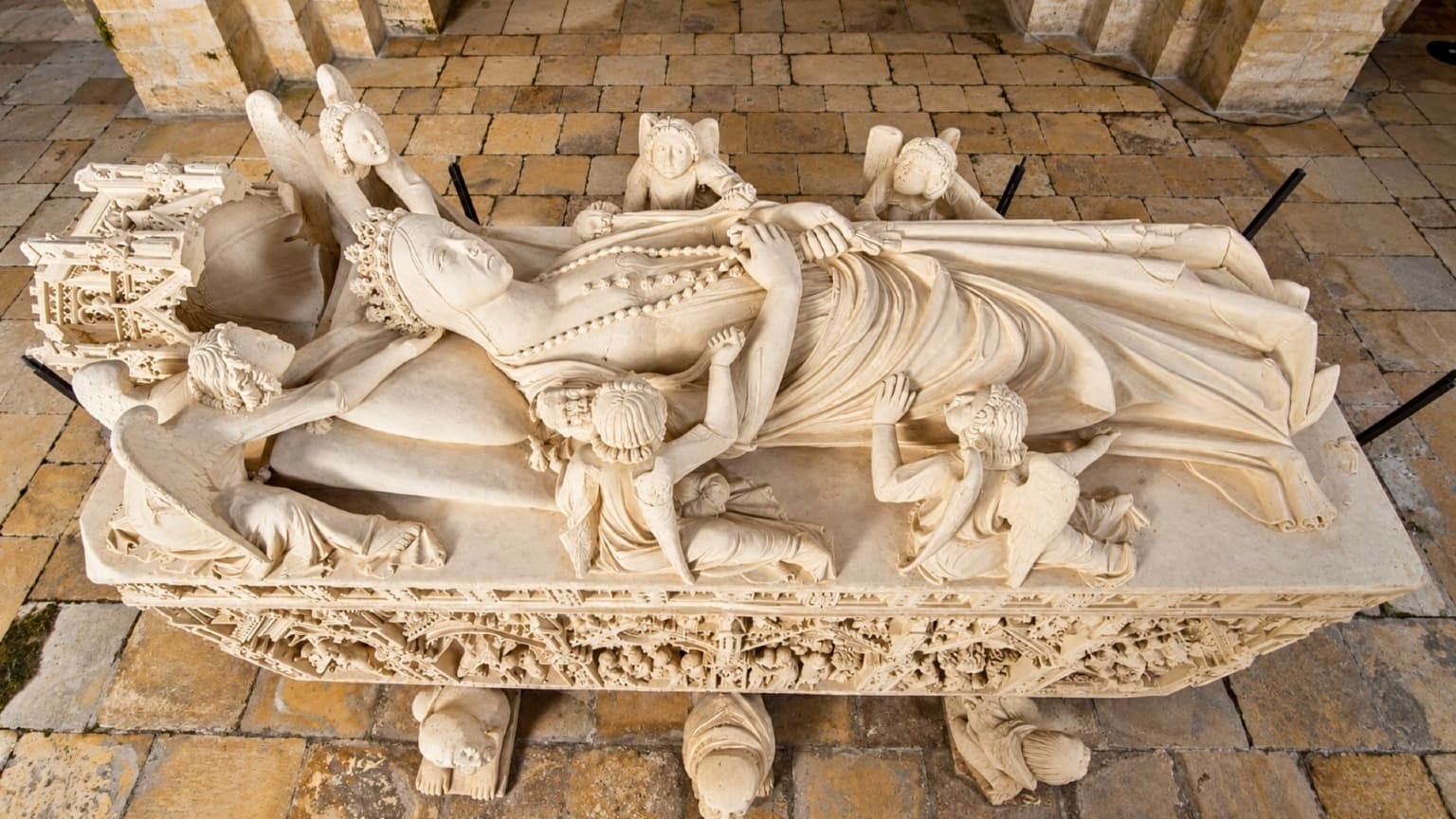
The richly sculpted tomb of Inês de Castro is one of Alcobaça's great artistic treasures and an outstanding example of Gothic funerary sculpture.
• Claustro de D. Dinis
The Claustro de D. Dinis is the monastery's only surviving medieval cloister and once formed the central point of circulation between the principal monastic spaces.
Completely vaulted and surrounded by elegant Gothic arches, it provides a quieter counterpoint to the scale of the church.
Rather than seeing the cloister simply as another architectural highlight, imagine it as part of everyday monastic life. From here, monks moved between prayer, meals, work, study and rest.
• Refectory and Dormitory
The Refectory reveals another part of that daily routine.
Meals were taken communally, while sacred texts could be read from the stone reader's pulpit as the monks ate. The size and architecture of the room demonstrate how carefully communal life was organised within the monastery.
Upstairs, the monks' Dormitory presents a very different atmosphere.
Originally a large communal sleeping space rather than a collection of private cells, its simplicity provides one of the clearest reminders of the austere lifestyle associated with the Cistercian community.
• The Monastery Kitchen
One of the most surprising spaces comes later in the monastery's history.
The enormous 18th-century kitchen is dramatically different from the restrained medieval spaces surrounding it. A monumental central chimney dominates the room, while water was channelled directly into the kitchen through the monastery's sophisticated hydraulic system.
UNESCO specifically highlights the kitchen and Alcobaça's hydraulic infrastructure when describing the monastery's importance as an exceptionally complete Cistercian establishment.
It is also one of the best places to appreciate something easily forgotten when visiting historic monuments: monasteries were complex communities that needed sophisticated systems for water, food, sanitation, agriculture and everyday life.
A UNESCO World Heritage Site
The Monastery of Alcobaça was inscribed on the UNESCO World Heritage List in 1989 under criteria (i) and (iv).
UNESCO recognises the monastery both as a masterpiece of Cistercian Gothic art and as an exceptional example of a major Cistercian establishment.
Its importance lies not only in the church or the tombs of Pedro and Inês, but in the remarkable survival of the monastery as a wider complex. The cloister, chapter house, refectory, dormitory, monks' room, hydraulic infrastructure and later kitchen help preserve an unusually complete picture of monastic life.
That is ultimately what makes Alcobaça so interesting to visit.
It is simultaneously a great work of architecture, a place connected with the origins of the Portuguese monarchy, a surviving medieval monastic complex and the setting for one of the country's most enduring stories.
How to Visit Alcobaça Monastery
The monastery stands in the centre of Alcobaça and can easily be explored as part of a journey through Central Portugal.
Allow around 1.5 to 2 hours if you want to visit the church, spend time examining the tombs of Pedro and Inês and explore the main monastic spaces without rushing.
The church itself can provide a powerful introduction to the monument, but the paid monastery circuit is worth including if you want to understand Alcobaça beyond its most famous tombs. The cloister, Refectory, Dormitory and Kitchen reveal a much more complete picture of how the community functioned.
Opening hours, admission prices and visitor conditions can change, so check the official Monastery of Alcobaça website before your visit rather than relying on older published information.
💡 Traveller tip: If Pedro and Inês are one of your main reasons for visiting, read their story before entering the monastery. Understanding what happened in Coimbra and what followed gives much greater meaning to the extraordinary tombs waiting inside Alcobaça.
Visit Alcobaça Monastery with a Local Guide
The architecture of Alcobaça is impressive on its own, but much of what makes the monastery fascinating lies in details that are easy to overlook: the principles behind Cistercian architecture, the symbolism of the royal tombs, the organisation of monastic life and the monastery's relationship with the beginnings of Portugal.
👉 Want to discover Alcobaça Monastery with a local guide? Explore our Private Alcobaça Monastery Tour, a curated experience offered by one of our trusted local partners and designed to bring the monument's history, architecture and stories to life.
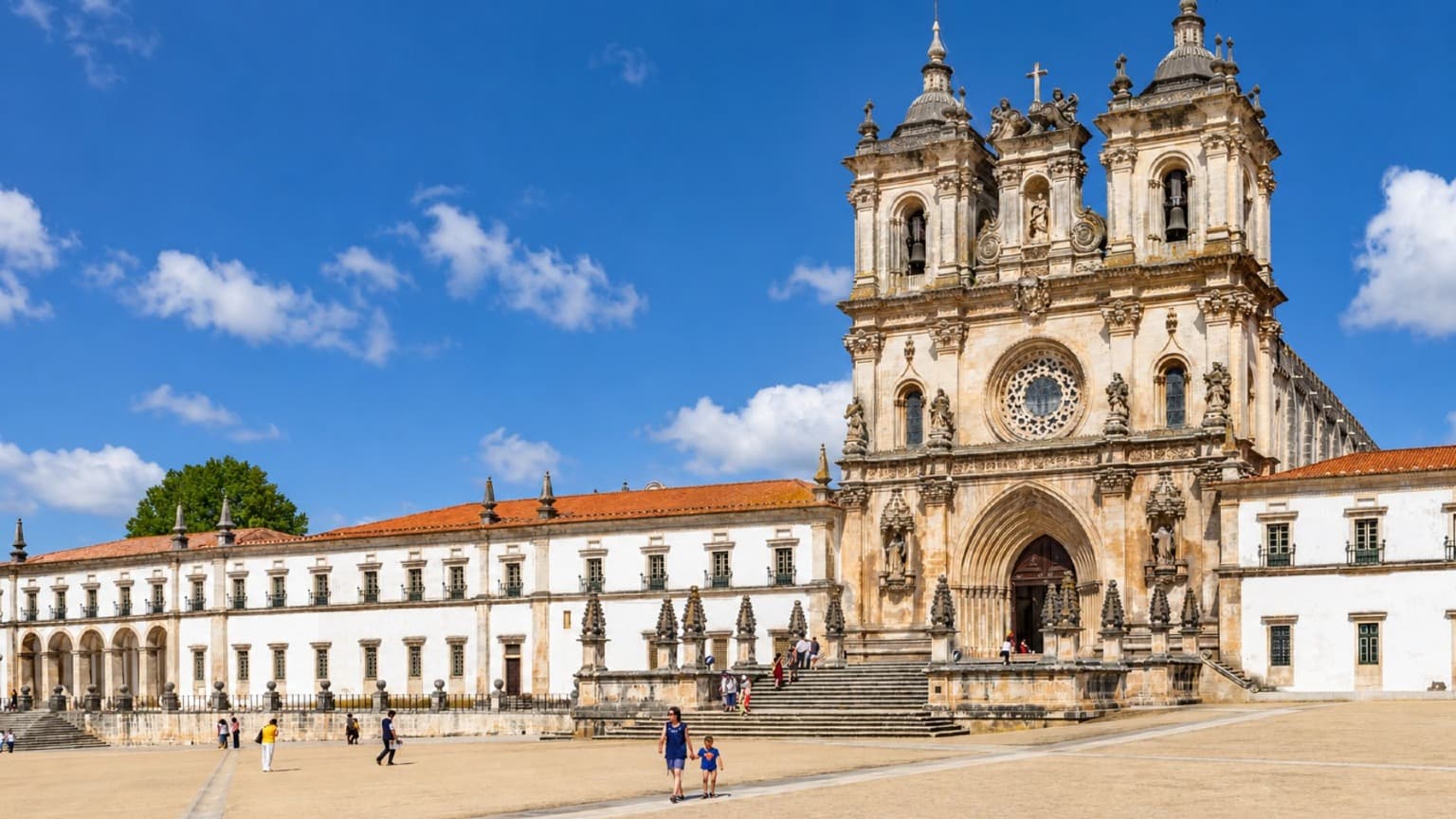
The Monastery of Alcobaça was founded in 1153 and became one of the most important Cistercian centres in medieval Portugal.
Exploring Central Portugal
Alcobaça fits naturally into a journey through Central Portugal.
Nearby, the Monastery of Batalha tells a very different chapter of Portuguese history, connected with the Battle of Aljubarrota, King João I and the emergence of a new royal dynasty. Nazaré brings you to the Atlantic coast, while Óbidos preserves one of Portugal's most distinctive medieval towns.
Further inland, Tomar and its Convent of Christ reveal yet another chapter in the country's religious and military history.
Together, these places show why Central Portugal deserves to be explored as much more than a route between Lisbon and Porto.
👉 Planning a longer journey through the region? Explore our Central Portugal Travel Guide for historic cities, monasteries, medieval towns, Atlantic landscapes and more places to discover beyond Alcobaça.
Frequently Asked Questions About Alcobaça Monastery
Written by the Cooltour Oporto team