Visiting Belém Tower & Jerónimos Monastery: Lisbon's UNESCO World Heritage Site
October 7, 2026
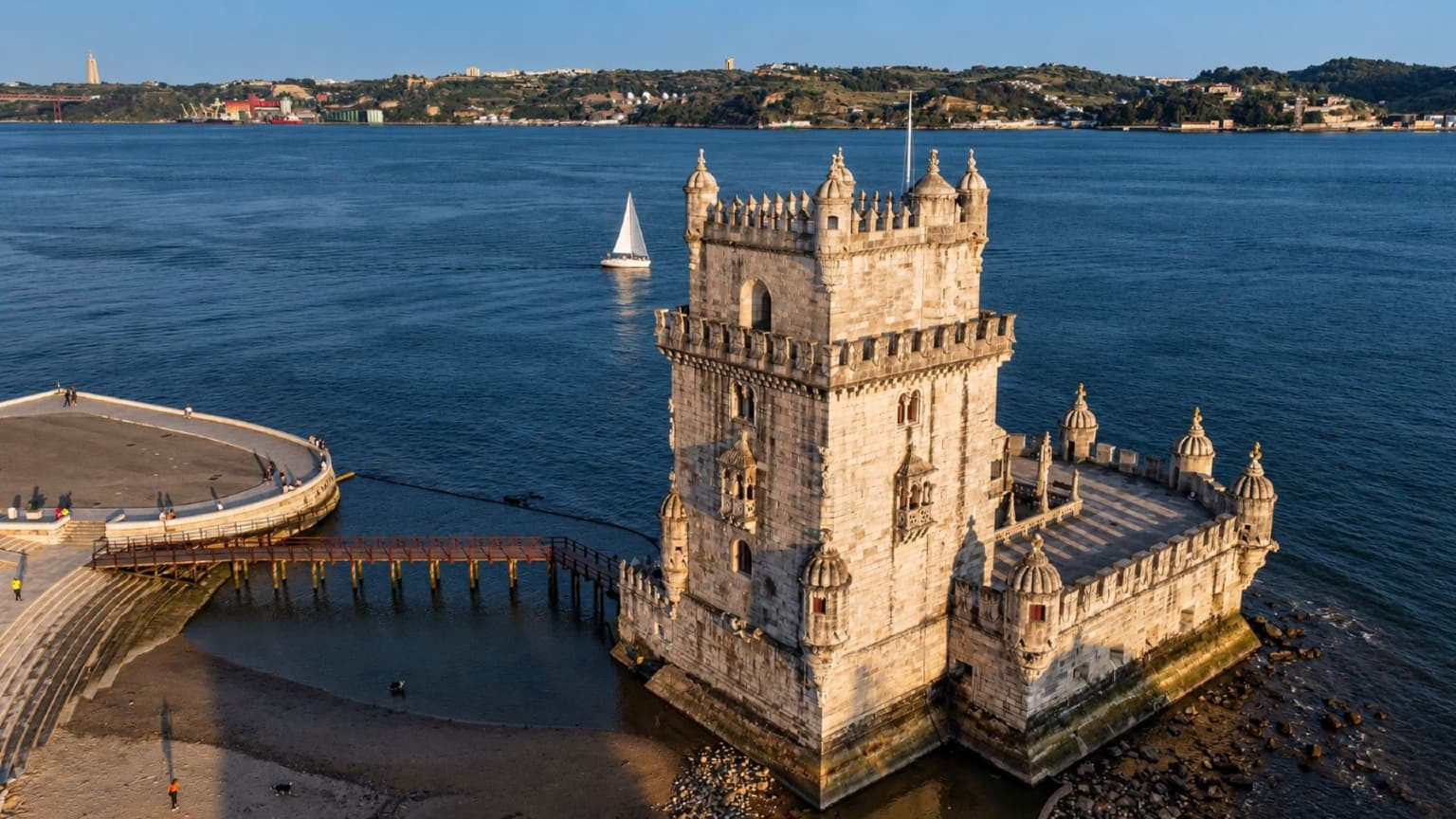
Belém Tower was built on the Tagus during the reign of Manuel I, forming part of the defensive system protecting Lisbon's maritime entrance.
Belém Tower and Jerónimos Monastery are two Manueline monuments commissioned by Manuel I and inscribed together as one UNESCO World Heritage Site in 1983.
On the banks of the Tagus River in Lisbon, two of Portugal's most recognisable monuments stand within walking distance of one another: the Jerónimos Monastery and Belém Tower.
Today, they may appear to be two separate landmarks. Historically, however, they belong to the same story.
Both were commissioned during the reign of King Manuel I, when Belém stood at the heart of Portugal's maritime expansion. The monastery rose beside the shore at Restelo, while Belém Tower was built out in the Tagus, helping to defend the entrance to Lisbon and the monastery itself. At the time, the relationship between the two was far more immediate than the modern waterfront suggests.
One was conceived as a monumental religious foundation. The other combined defence with the symbolic power of a ceremonial gateway to Lisbon. Together, they preserve an architectural record of an era that transformed Portugal and connected Lisbon with increasingly distant parts of the world.
At a Glance
Location: Belém, Lisbon
Jerónimos Monastery: Construction began in 1501 or 1502
Belém Tower: Built between 1514 and 1519
Commissioned by: King Manuel I
Architecture: Manueline, with Gothic and Renaissance influences
UNESCO: World Heritage Site since 1983
Don't miss: Jerónimos Church and Cloister, South Portal, Vasco da Gama's tomb, Belém Tower's bastion, Manueline stonework and terrace
Allow: Around 2.5–3 hours for both monuments, excluding significant queues
Two Monuments, One Story
To understand the Jerónimos Monastery and Belém Tower, it helps to imagine Belém before the gardens, avenues and museums that surround them today.
At the end of the 15th century, Restelo was a small settlement and sheltered harbour on the edge of Lisbon. Its importance grew as Portuguese ships began undertaking increasingly ambitious ocean voyages. An earlier hermitage stood here, associated with sailors departing from the Tagus. Vasco da Gama prayed and kept vigil there before his fleet left for India in July 1497, and Pedro Álvares Cabral's fleet later departed for Brazil.
King Manuel I transformed this landscape by commissioning the great monastery that would become the Jerónimos Monastery and later ordering the construction of Belém Tower. The Tower had a practical defensive purpose, protecting Lisbon's port and the Tagus estuary, but the official history of the monastery records another important function: it was also intended to help protect the monastery itself.
Their original setting made that relationship much clearer. The monastery stood on the bank facing Restelo beach, while the Tower was built in the river on a basalt outcrop, approximately 250 metres from the shore.
The modern city has changed the landscape around them, but the historical connection remains fundamental to understanding both monuments.
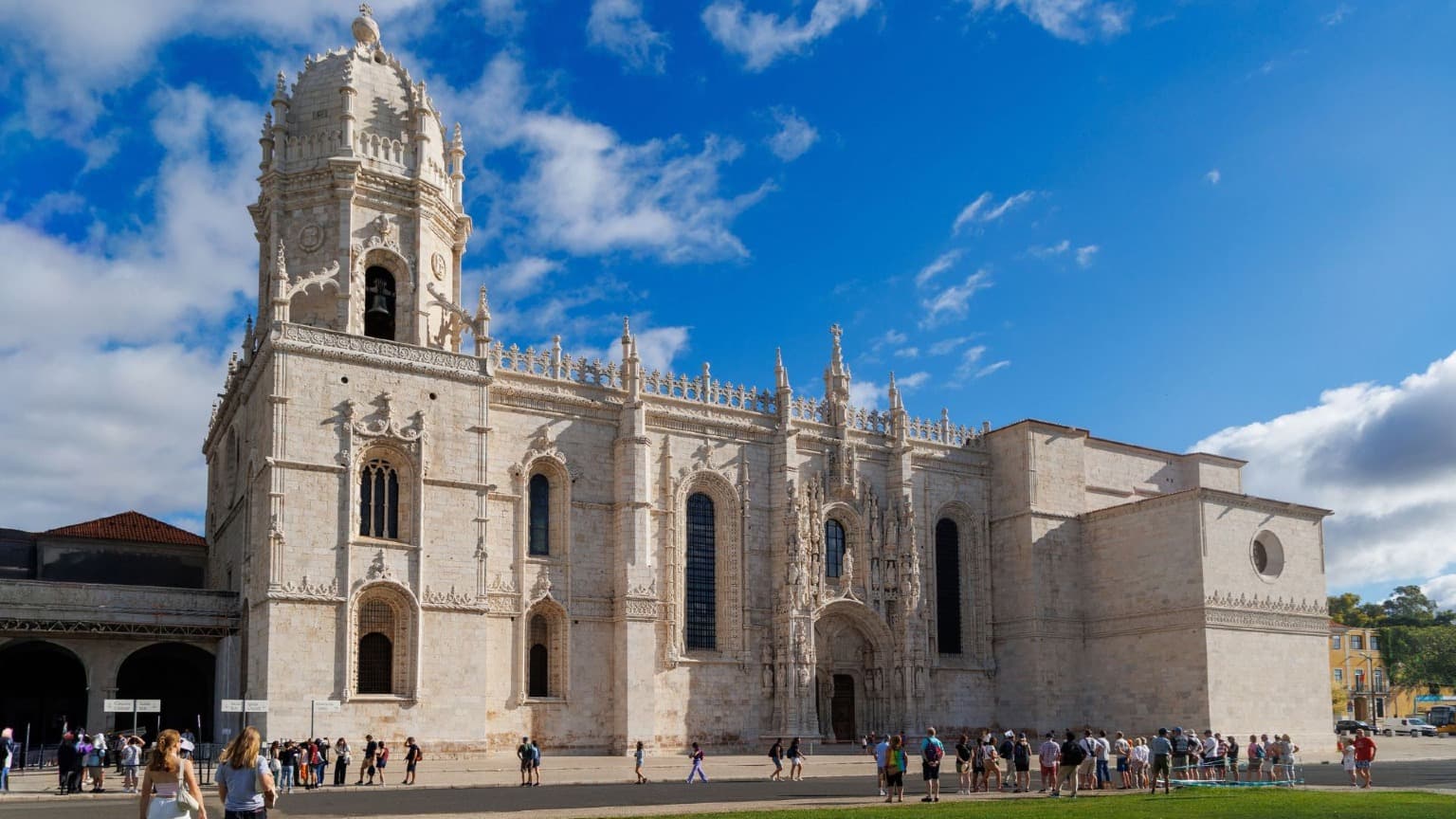
Jerónimos Monastery was commissioned by Manuel I beside the Tagus, forming part of the transformation of Belém during Portugal's maritime expansion.
Why Are Belém Tower and Jerónimos Monastery One UNESCO World Heritage Site?
UNESCO inscribed the Monastery of the Hieronymites and Tower of Belém in Lisbon on the World Heritage List in 1983.
Although physically separate, UNESCO considers them together as the monumental complex of Belém and recognises their exceptional connection with Portuguese culture during the 15th and 16th centuries and the maritime voyages that established new intercontinental routes.
The two monuments also share the architectural language most closely associated with the reign of Manuel I: the Manueline style.
Developed during a period of intense royal patronage, Manueline architecture combined elements of late Gothic architecture with royal, religious, naturalistic and other decorative influences. The armillary sphere, the Cross of the Order of Christ and the royal coat of arms became particularly important symbols.
Jerónimos is traditionally regarded as the high point of this architectural language.
Together, the monastery and Tower therefore tell a much larger story than their individual functions suggest. They reflect religion, royal power, navigation, artistic exchange and Portugal's expanding connections with Africa, Asia and the Americas.
Those connections also had darker consequences. Maritime expansion brought trade and cultural exchange, but was accompanied by conquest, colonial domination and slavery. Understanding this broader context gives the monuments greater historical meaning without diminishing their artistic importance.
Jerónimos Monastery
From a Small Hermitage to a Royal Monastery
The story of Jerónimos begins before the present monastery existed. In 1459, Henry the Navigator ordered the enlargement of an earlier hermitage at Restelo. Later known as Santa Maria de Belém, it became closely associated with the sailors leaving from this stretch of the Tagus.
After becoming king in 1495, Manuel I requested permission from the Holy See to establish a monastery for monks of the Order of Saint Jerome on the site. Permission was granted the following year, and the monarch subsequently assigned Restelo to the Order for the construction of the future monastery.
The first stone was laid between 1501 and 1502.
The scale of the project reflected the ambitions of Manuel's reign. Constructed largely from pale lioz limestone quarried around Lisbon, the monastery required substantial financial and artistic resources and brought together architects and sculptors from different parts of Europe.
Why Is It Called Jerónimos Monastery or Hieronymites Monastery?
The monument's formal historical name is the Royal Monastery of Santa Maria de Belém.
However, it became commonly known in Portuguese as the Mosteiro dos Jerónimos because it was founded for the Order of Saint Jerome, whose monks occupied the monastery for more than three centuries.
This also explains the two English names travellers may encounter.
Jerónimos Monastery retains the familiar Portuguese name and is the form most commonly associated with the monument today. Hieronymites Monastery refers to the same religious order and is the terminology used in UNESCO's official English name for the World Heritage property. Both names refer to the same monument.
The Architecture of Jerónimos Monastery
Jerónimos was not the work of a single architect. The first major phase was directed by Diogo Boitaca, who planned much of the initial structure and oversaw construction between 1502 and 1516. Boitaca drew on late Gothic forms and filled them with royal and religious emblems and naturalistic detail, helping to define what became the Manueline style.
From around 1516, João de Castilho became increasingly involved, eventually taking over the direction of the project. Under Castilho, construction accelerated and the architecture began incorporating influences ranging from Plateresque decoration to the emerging language of the Renaissance.
Later architects continued to shape the monastery, meaning that what visitors see today reflects both the ambition of Manuel I's original project and subsequent centuries of construction, adaptation and restoration.
What to See Inside Jerónimos Monastery
• The Church of Santa Maria de Belém
The church is one of the monastery's most impressive spaces, with a soaring interior supported by richly decorated pillars that appear remarkably slender in relation to the vault above them. Complex networks of stone ribs spread across the ceiling, creating an interior that feels both monumental and unusually unified.
Near the entrance are two of the monastery's best-known tombs: that of Vasco da Gama, whose voyage established the sea route between Europe and India, and the tomb honouring Luís de Camões, author of Os Lusíadas, created in 1880.
The main chapel also became a royal burial space, containing the tombs of Manuel I, Queen Maria, João III and Queen Catarina.
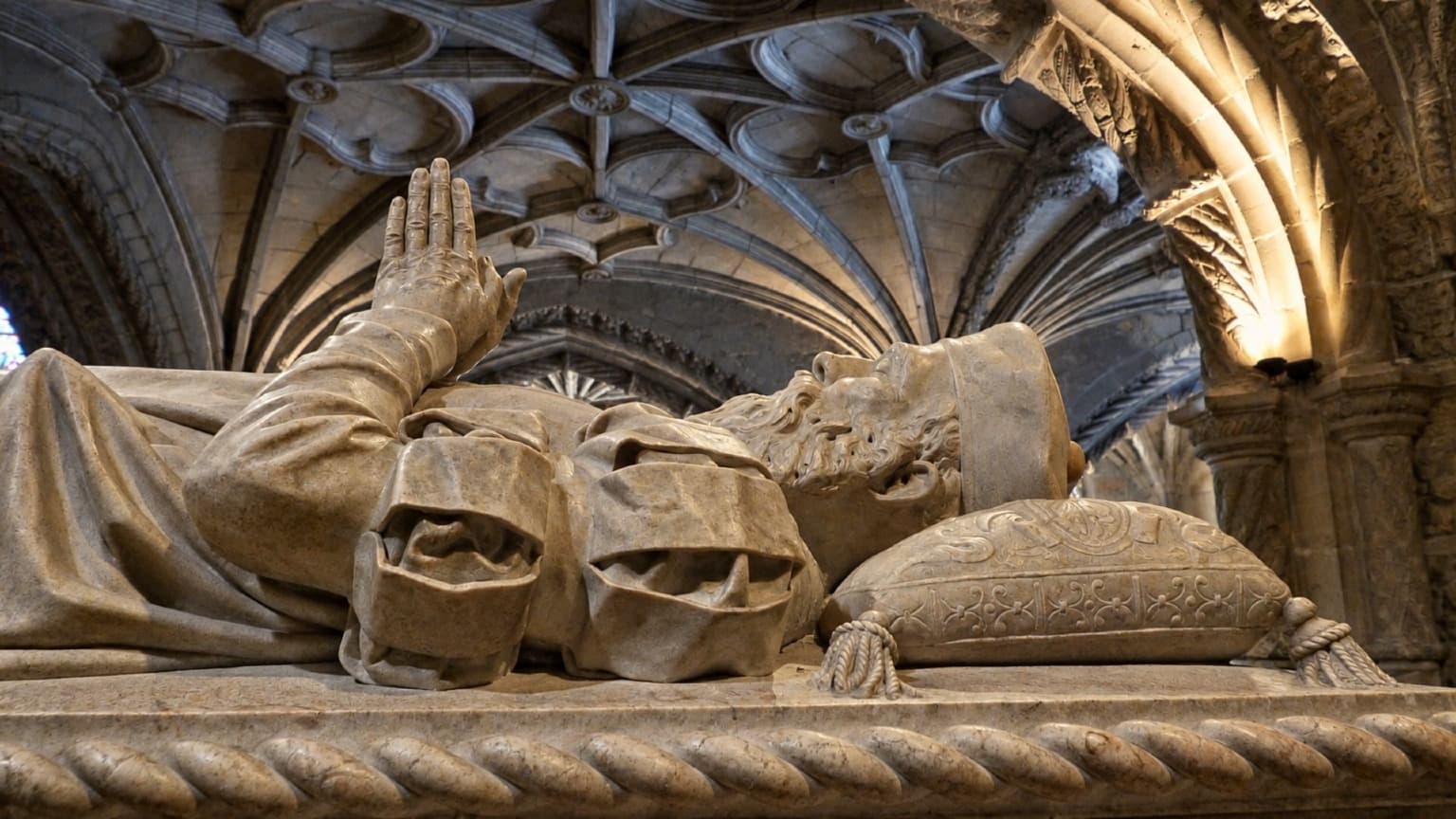
Vasco da Gama's tomb stands inside the Church of Santa Maria de Belém, linking Jerónimos directly with the maritime voyages that shaped this part of Lisbon.
• The South Portal
Facing what is now Praça do Império, the monumental South Portal is one of Jerónimos' great sculptural achievements.
Created under João de Castilho in the 1510s, its dense sculptural programme includes prophets, apostles, saints and other religious figures. Santa Maria de Belém appears at its centre, while the Archangel Michael stands above.
Although visually spectacular, this is not the church's principal entrance, something that can easily surprise first-time visitors.
• The Cloister
If there is one space that fully expresses the artistic ambition of Jerónimos, it is the cloister.
Planned during Boitaca's early phase and subsequently completed by João de Castilho and Diogo de Torralva, its two levels combine intricate stone carving with a remarkable sense of balance and proportion.
Look closely and the decoration reveals vegetal, heraldic, religious and fantastical motifs woven into the architecture.
The cloister was originally a place of prayer and meditation for the monks. Today it also contains the tomb of Fernando Pessoa, whose remains were transferred here in 1985.
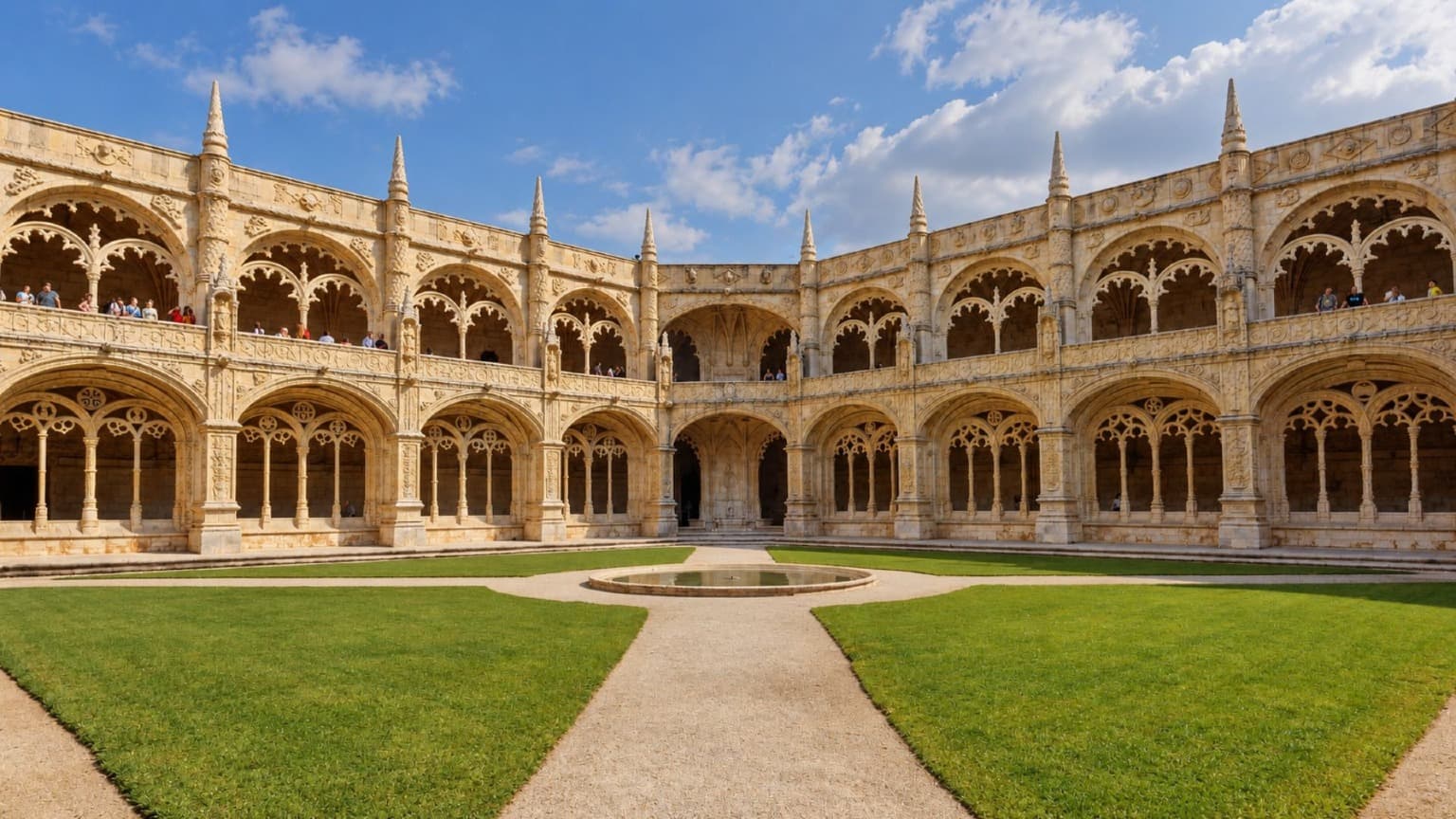
The two-level cloister is one of the finest expressions of Manueline architecture at Jerónimos, with carved stone that rewards a closer look.
• The Former Refectory
The former monks' refectory offers a very different atmosphere. Built between 1517 and 1518, the long room is covered by a ribbed vault and later decorated with 18th-century azulejo panels depicting scenes from the biblical story of Joseph in Egypt.
It is an excellent reminder that Jerónimos was not simply a royal monument. For centuries, it was also a functioning monastery shaped by the everyday routines of religious life.
From Jerónimos to Pastéis de Belém
The history of Jerónimos also has an unexpected connection with one of Portugal's most famous pastries. Following the closure of the monastery in the 19th century, the story of its former religious community became closely connected with the origins of the Pastéis de Belém tradition.
👉 Discover the full story in our guide to Pastel de Nata: The Real History Behind Portugal's Most Famous Pastry.
Belém Tower
A Fortress at the Gateway to Lisbon
A short walk from the monastery brings you back to the Tagus and to one of Lisbon's defining silhouettes.
King Manuel I ordered the construction of Belém Tower as part of the defence of Lisbon's river entrance. Work began in 1514, with Francisco de Arruda associated with its design and construction.
Unlike the monastery, whose scale unfolds across a large religious complex, Belém Tower compresses military architecture, royal symbolism and elaborate decoration into a remarkably compact building.
Its original setting was also very different from what visitors see today. The Tower was constructed on a basalt outcrop in the Tagus, allowing its artillery to defend the approach to Lisbon while creating a striking landmark for ships arriving and departing along the river.
The Architecture of Belém Tower
Architecturally, Belém Tower combines a low polygonal bastion designed for artillery with the four-storey tower rising behind and above it, drawing on the tradition of medieval fortified keeps. Yet this was never simply a functional fortress. The exterior is covered with symbols and decorative details associated with Manuel I and the period in which it was built. Armillary spheres, crosses of the Order of Christ, royal heraldry and carved stonework transform a military structure into an expression of royal power.
Its projecting watchtowers and elaborate ornament also give Belém Tower a character quite unlike a conventional European fortress.
The Rhinoceros of Belém Tower
One of the Tower's smallest details tells one of its most memorable stories. Carved beneath one of its watchtowers is the head of a rhinoceros.
The animal is generally associated with the rhinoceros brought from India to Portugal in 1515 during the reign of Manuel I. Its arrival caused great curiosity in Europe, where living rhinoceroses had not been seen for centuries.
The carving is easy to miss, but it perfectly captures the world in which Belém Tower was created: a Lisbon increasingly encountering animals, objects, people and ideas arriving through expanding maritime networks.
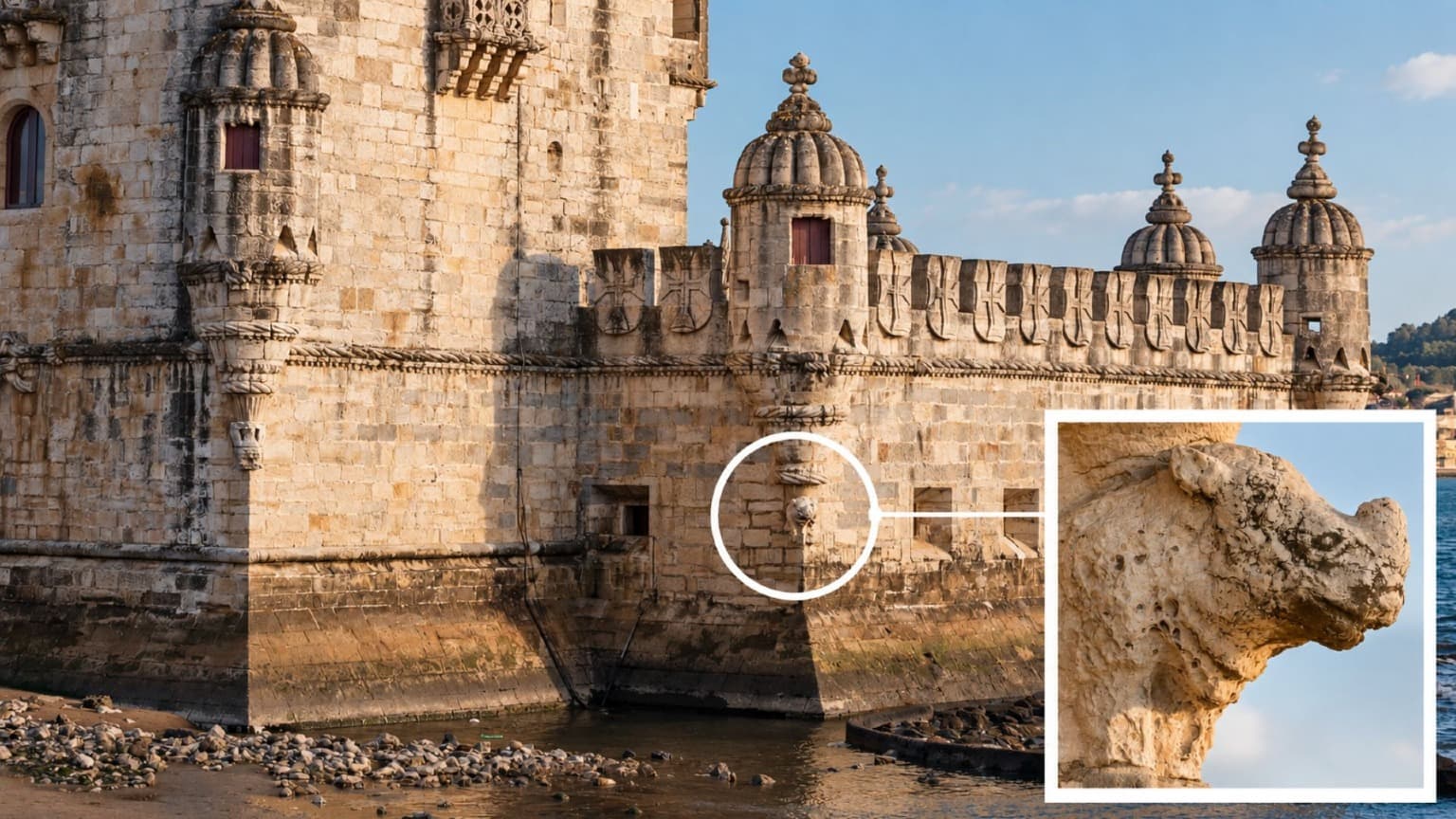
The carved rhinoceros head sits beneath one of Belém Tower's watchtowers, a reminder of Lisbon's links with distant lands.
What to See Inside Belém Tower
The lower bastion reveals the Tower's military purpose most clearly, with openings designed for artillery facing the river.
From there, visitors can move upward through the Tower's different levels, including spaces traditionally known as the Governor's Hall, King's Hall and Audience Hall, before reaching the chapel and upper terrace.
The narrow spiral staircase is itself part of the experience and a reminder of the Tower's origins as a 16th-century fortification.
At the top, the terrace opens onto the Tagus and the wider landscape of Belém.
From here, the connection between monument, river and city becomes much easier to understand.
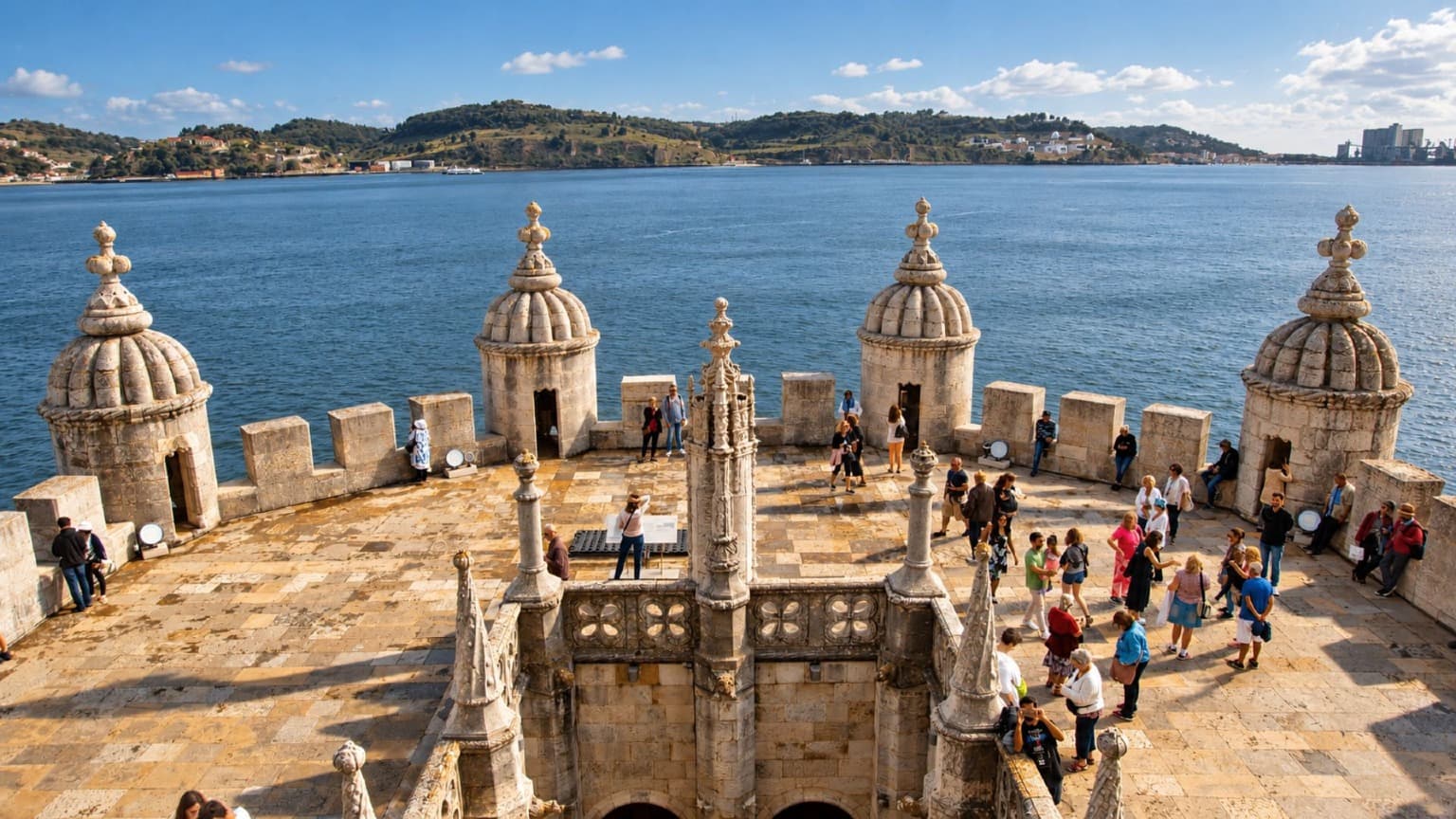
From the upper terrace of Belém Tower, the Tagus once again becomes central to understanding the monument's relationship with Lisbon and its maritime history.
Understanding the Two Monuments Together
The relationship between Jerónimos Monastery and Belém Tower becomes clearest when they are viewed as part of the same historical landscape.
The monastery represents the religious, dynastic and artistic ambitions of Manuel I's reign, while the Tower represents defence, navigation and royal power at Lisbon's maritime gateway.
Both emerged from the same historical moment, both were shaped by the Tagus, and both use architecture to communicate something about the Portugal that created them. That shared history ultimately explains why UNESCO recognises them as a single World Heritage property.
How to Visit Jerónimos Monastery and Belém Tower
The two monuments are close enough to visit comfortably together and are best understood as part of the same historical experience.
Allow around 2.5 to 3 hours if you intend to explore both interiors at a relaxed pace, although queues can considerably increase the total time required.
Jerónimos deserves enough time for both the church and the cloister, while Belém Tower is considerably smaller but can take longer than expected because movement through its historic interior is naturally restricted.
Tickets are frequently in high demand, and the official monument information recommends purchasing them in advance whenever possible.
👉 Official tickets: Buy tickets online for the Jerónimos Monastery or Belém Tower through MEO Blueticket, the official ticket supplier. Opening hours, prices and visitor conditions can change, so check the official pages for the Jerónimos Monastery and Belém Tower before your visit.
Visiting Both Monuments on the Same Day
Visiting Jerónimos and Belém Tower together is easy and, historically, makes much more sense than seeing either monument in isolation. If possible, give yourself enough time to walk between them. The riverside setting is part of their story.
And there is much more between and around them than these two monuments alone. The Padrão dos Descobrimentos, museums, gardens, Pastéis de Belém, cultural spaces and the Tagus waterfront can easily turn a visit to the UNESCO monuments into half a day or an entire day in this part of Lisbon.
Visit Belém with a Local Guide
The relationship between Jerónimos Monastery, Belém Tower and the Tagus becomes even more meaningful when explored within the wider history of the neighbourhood.
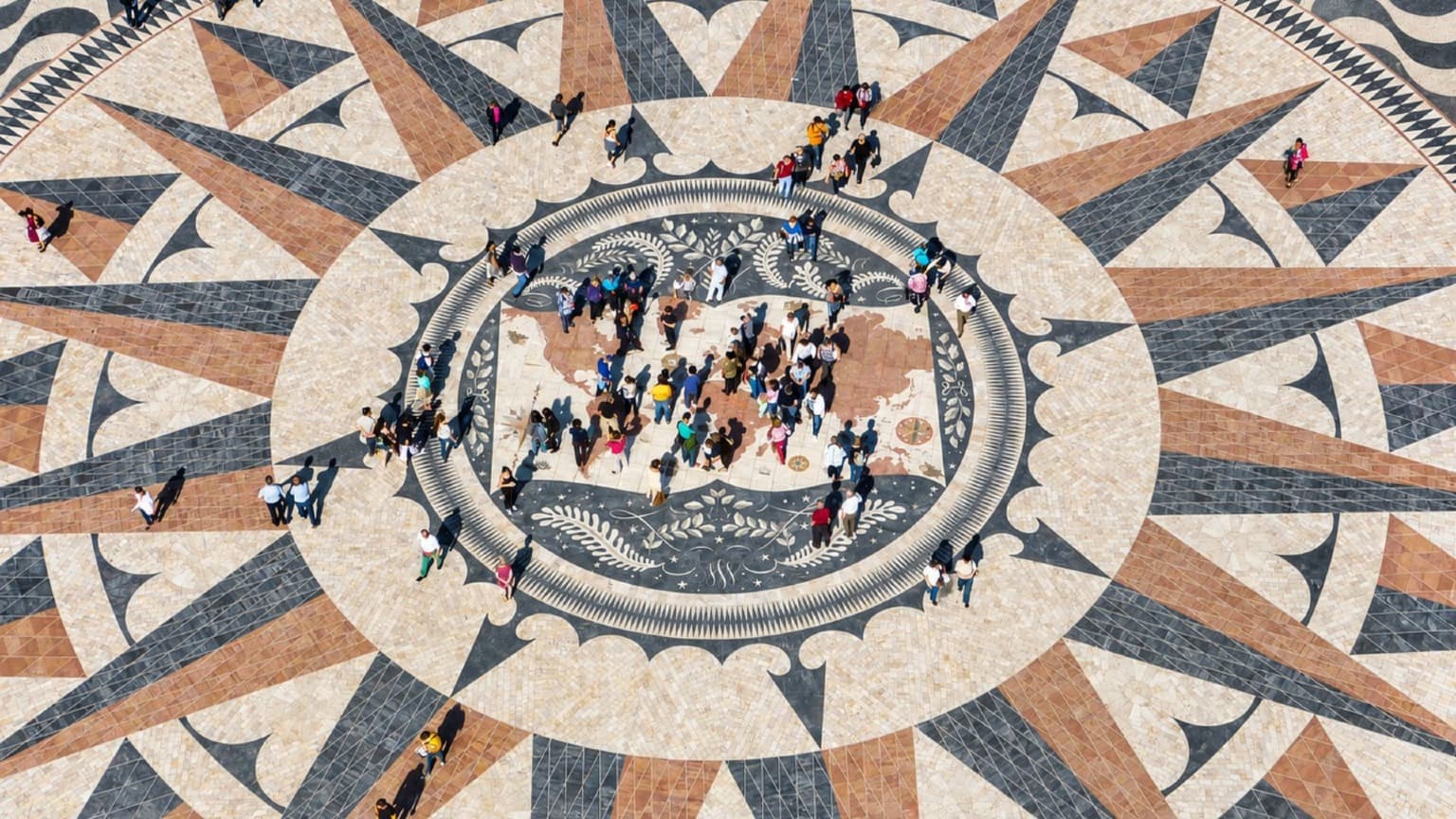
Exploring Belém on foot brings its monuments, maritime history and relationship with the Tagus together within the wider story of the neighbourhood.
👉 Want to discover Belém with a local expert? Explore our Private Belém Walking Tour, a curated experience offered by one of our trusted local partners that explores the area's monuments and maritime history, providing the context that connects Belém with Portugal's Age of Discoveries.
Continue Exploring Belém and Lisbon
Jerónimos Monastery and Belém Tower may be Belém's most internationally recognised monuments, but they are only part of what makes this riverside district worth exploring.
Historic pastry shops, museums, gardens, contemporary cultural spaces, monuments and long walks beside the Tagus make Belém one of the most rewarding areas of Lisbon to explore at a slower pace.
👉 Planning to spend more time here? Discover our complete guide to visiting Belém in Lisbon, including what to see, where to eat and how to make the most of the neighbourhood.
👉 And if Belém is only one part of your stay, explore our Lisbon Travel Guide for more ideas, experiences and places to discover across the Portuguese capital.
Frequently Asked Questions About Belém Tower and Jerónimos Monastery
Written by the Cooltour Oporto team